
Dawn
Bringing nature's colour into hospital spaces
Dawn makes monochromatic necklaces from elements gathered from the natural world, bringing nature's colour into the courtyard windows of Dorset County Hospital.
A quiet intervention
There is a courtyard at Dorset County Hospital that most people don't notice they’re circling.
In it stands a small bronze dog by Elisabeth Frink, keeping quiet vigil. Frink understood something about the relationship between the animal world and human vulnerability.
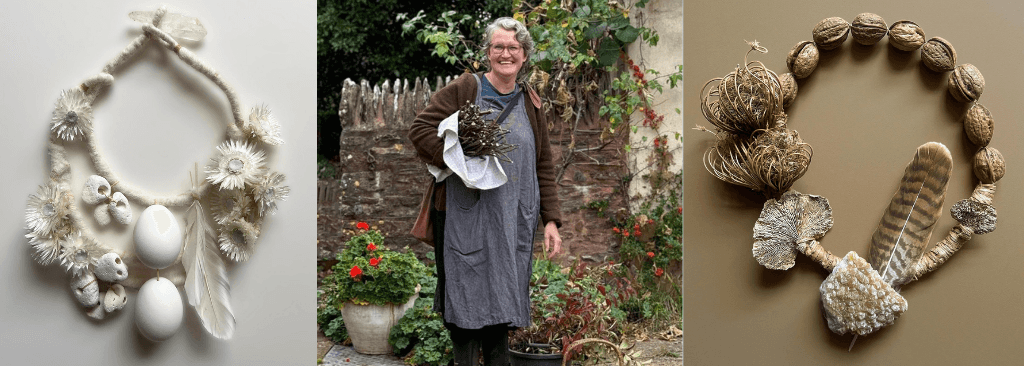
This summer, five small objects by Dawn Weller will join the bronze dog on the interior windowsills that wrap around the Frink courtyard. These will be handmade necklaces, each one monochromatic, each composed entirely from elements gathered from the natural world.
One will be in whites: bleached hag stones threaded onto sheep’s wool, dried everlasting flowers, a raw quartz crystal, suspended eggs, two tied feathers.
Alongside this will sit four others: pale wheat greens, pigeon greys, walnut browns, and straw yellows. Five colours found on a quiet walk.
Each piece draws from the same three sources — animal, mineral, and plant — held still. Each one symbolic, representing protection from the outside world and immersion in colour and nature.
The materials and colours are biophilic. The nervous system recognises them and is soothed.
The community this work is built around
A hospital community is not one thing.
Dawn’s work is made for all of them, and it understands that each needs something slightly different.
For the patient, the work offers genuine visual rest and distraction. Something that doesn’t demand interpretation, but simply slows the eye and body.
For the family member or visitor, often the most overlooked person in a clinical environment, the work offers a fragment of the outside world in a space that can feel entirely sealed off from it.
For staff, whose working environment is rarely considered an aesthetic one, the work offers evidence that someone has paid attention. And that attention is not incidental to care, it is an expression of it.
And on a broader level, there’s also another person.
She has navigated burnout, illness, overwhelm, or sustained caregiving, and has become acutely sensitive to environments as a result. Visually sensitive, drawn to texture and tonal restraint, she is not looking for instruction about how to feel. She is looking for space to feel something for herself.
Dawn knows her because she has been her, treated for breast cancer at Bart’s Hospital in London, and changed by the art in the waiting areas in ways she is still tracing.
That feeling of being cared for, not just treated, became the starting point for her practice.
Learning to look
Before anything reaches a hospital windowsill, there is a walk.
The slow, attentive gathering of natural elements in a single hue — scanning a shoreline for stones of one colour, sorting feathers by the quality of their white — is itself a restorative practice.
The making carries that quality of attention inside.
This discipline of learning to see variation within a single colour register is at the heart of everything Dawn teaches and makes. It is slow, absorbing, and cumulative. It cannot be done while worrying about something else.
And it can be taught.
How the work contributes
The exhibition is one strand of a broader community practice.
Dawn is planning to present a larger body of work by creating a series of chest pieces representing armour. Again, each one will be made from elements of nature in one matching colour, woven together.
Alongside each will be a display of the individual specimens included in that art piece. They will be displayed either in box frames or as photographs, depending on the requirements of each site.
She has also proposed The Armour Project workshop to various hospitals, bringing natural materials directly to patients and staff — dried botanicals, undyed wools, shells, feathers, and stones — activating the same biophilic response through touch and making.
Future offerings will include guided colour walks in nature, and workshops built around creating specimen displays: arranging natural elements by tone, learning to look at colour variation as a contemplative, collective practice.
Each strand serves the community at a different level of engagement, from the patient who passes a windowsill without stopping, to the staff member who can spend an afternoon with their hands in the natural world.
Looking ahead
Dawn is currently contributing as a volunteer editor and art historian at The Colour Club, developing the intellectual framework that underpins this work: the therapeutic qualities of colour in nature and the science of biophilic response.
She is also planning to bring this all together in a book for practitioners, commissioners, and general readers alike.
Nature and colour know how to hold people.
This work carries that knowledge inside.
Follow Dawn’s Story & Work!
Dawn Weller is an artist and colour practitioner.
Her exhibition opens at Dorset County Hospital from July 2026 to September 2026.
Instagram: @dawnwellerstudio

